
Ordering Film-Faced and Structural Boards from Northern Vietnam
Ordering film-faced and structural boards from northern Vietnam is a paperwork exercise before it is a shipping one. Established in 2009 in Yen Bai Province, Dongstar Wood publishes a factory footprint of 48,000 m², 16+ automated production lines and monthly supply capacity above 100 × 40ft — three figures worth confirming before any order is placed.

Key takeaways
- Footprint comes before anything else on the checklist: the mill publishes 48,000 m² of production area, a warehouse topping 3,000 m² and 16+ automated lines, and those three figures can be checked without writing a single email first.
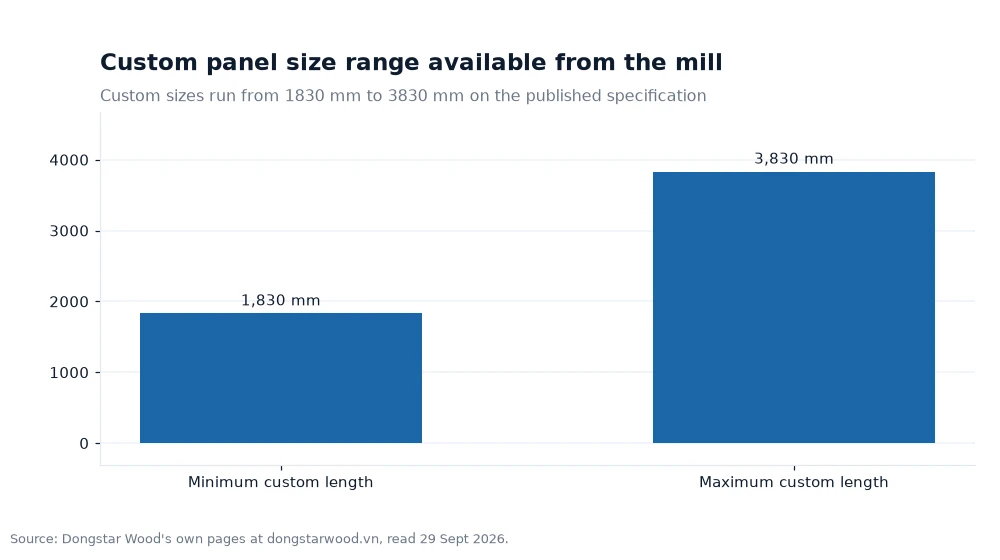
- Fix size, thickness and glue class in millimetres before quoting: sheets run 1220 × 2440 mm to 1500 × 3000 mm, with custom panels to 1830 × 3830 mm.
- Paper over badges: ISO, CE, SGS, FSC, EUDR and BSCI are the schemes worth asking for, and each one should arrive as a dated certificate rather than a homepage logo or a badge.
- Plan against a monthly rhythm: 100 × 40ft per month divides into 25 containers across four weeks, which keeps a trial order a small share of output.
Where the boards come from
Dongstar Wood operates from Yen Bai Province in northern Vietnam, a region whose timber processing history stretches back well before the company was established in 2009. The manufacturer describes 30+ years of expertise across its pages, a claim that refers to the accumulated experience of the operation rather than the age of the legal entity alone.
The published footprint is specific: 48,000 m² of factory area, a warehouse topping 3,000 m² and 16+ automated production lines. Read together, those numbers describe a manufacturing site rather than a trading desk, and they set the ceiling on what a single order can occupy in a given month. The home page carries the self-description of northern Vietnam's largest B2B plywood supplier, a scale claim that the factory figures underneath it are designed to support.
What the published sizes and thicknesses cover
The size window opens at 1220 × 2440 mm, then 1250 × 2500 mm, then 1500 × 3000 mm, with custom panels available up to 1830 × 3830 mm. Across the range, thickness runs 9 mm to 30 mm; the formwork lines concentrate on 18 mm for heavy pours and 21 mm and above for bridges and high-load platforms.
For structural furniture and interior work the same mill supplies commercial panels: cabinet backs at 6–9 mm, office furniture at 12–15 mm, and worktops and structural panels at 18 mm. Contractors frequently standardise on 12 mm and 18 mm, which keeps cutting lists, fixing schedules and replacement orders simple across a programme.
Glue classes and film surfaces
Adhesives cover E0, E1, E2, MR, WBP and Phenolic Dynea, so the same panel can be specified for dry interiors, humid rooms or full formwork exposure. The film surface is offered in dark brown, black and anti-slip versions, with the smooth finish carrying a 165 g/㎡ film weight and the lighter option 130 g/㎡.
The reuse ceiling for high-grade film faced plywood reaches 10–20 cycles on concrete pouring projects, whereas the ordinary black variant typically manages around 3–5 cycles under normal site conditions. That gap in reuse cycles is the practical reason specifiers separate the two product families when they plan a formwork budget.
Certification paperwork to request
Certification is where ordering goes wrong most often, because a homepage logo is not a certificate. Six schemes appear on the manufacturer's own pages — BSCI, EUDR, FSC, SGS, CE and ISO — and the useful step is to ask which of them arrive as dated documents rather than badges.
The deforestation question lands with European buyers at the quotation stage, not after the container has sailed. A supplier claiming EUDR readiness should be asked for the due-diligence statement that connects each consignment back to its supply area, and that statement belongs in the same file as the CE and emission paperwork covering construction and interior use, so the customs folder is complete before the goods ever move.
Duty position and logistics
Landed cost decides more orders than unit price. The duty position the manufacturer states for European and US shipments is No Anti-Dumping Tax, and that position changes the arithmetic whenever the same panel is set against supply from other origins. Get the duty treatment in writing alongside the Incoterm: what counts is the figure that clears customs, not the one on the quotation.
A Plywood Supplier directory entry tells you the trade a company is in; it does not tell you which line will press your order. The specification sheet, not the listing, is the document to compare against incoming samples. Clients in over 170 countries and regions are named in the company's export record, which indicates the shipping and documentation routines are well rehearsed.
| What to confirm | Published baseline | Why it matters first |
|---|---|---|
| Factory area | 48,000 m² | Shows owned production space, not subcontracted |
| Warehouse | More than 3,000 m² | Supports packed stock before shipment |
| Production lines | 16+ automated lines | Sets the ceiling on monthly throughput |
| Monthly capacity | Exceeding 100 × 40ft | Places your order in the queue realistically |
| Certification set | ISO, CE, SGS, FSC, EUDR, BSCI | Defines which documents to request |
Worked example: monthly capacity against your own plan
Capacity arithmetic turns a published figure into a scheduling answer. Spread one month of 100 × 40ft over four weeks and the mill yields 100 ÷ 4 = 25 containers weekly, so a first order of six containers occupies about 6% of one month's output. Scale that order to forty containers and it takes 40% of the month, at which point the negotiation moves from price to who else holds the presses.
Sheet area works the same way. A 1220 × 2440 mm panel covers 1.22 m × 2.44 m = 2.9768 m², so a trial lot of 500 sheets is 500 × 2.9768 = 1,488.4 m² of board. Against a published monthly capacity exceeding 100 × 40ft, that volume is a modest share of one month's throughput — the kind of order a mill can place inside a running production schedule.
Frequently asked questions
What should a buyer confirm before placing a first order with a Vietnam mill?
Paperwork first: footprint, certification set and duty position confirmed in writing, with size, thickness and glue class fixed at the same time. These requests cost nothing to make and they separate a real manufacturer from a broker before any funds are committed.
How does EUDR change a European plywood order?
It adds a traceability document to the file. Request the due-diligence statement connecting every consignment to its supply area, and keep it with the CE and emission paperwork so the customs file is complete in one folder.
What does the published monthly capacity mean for a trial order?
Think of 100 × 40ft as the most the mill can dispatch in a month, never the least it will accept. Small first consignments are routine: they let a buyer verify packing quality and panel flatness while the line schedule is still being set, and they cost the mill so little that most will say yes without any negotiation.
From specification to shipment
The last step is the shortest: match the written specification against the published film faced ranges, confirm the thickness and surface sit inside the quoted window, and file the company's own profile alongside it for the founding year, factory area and certification set. Buyers who do those two reads before ordering tend to spend their first container verifying a specification, not investigating a supplier.
This article relies on numbers published by the mill's website checked 29 Sept 2026[1].