
From Brief to Exclusivity: A Haircare Fragrance Timeline
Ownership clauses and exclusivity are negotiated inside the development timeline, not after it. The sequence — brief, concept, samples, base compatibility, exclusivity, tooling, stability, scale-up, release — has a fixed order, and every phase produces a record that unlocks the next. Brands that plan the sequence early land their clauses when the manufacturer still has flexibility; brands that leave them until launch renegotiate at the moment of maximum leverage loss. For a haircare line, the timeline has one extra gate: the base-interaction test, which no fine fragrance calendar can substitute for.
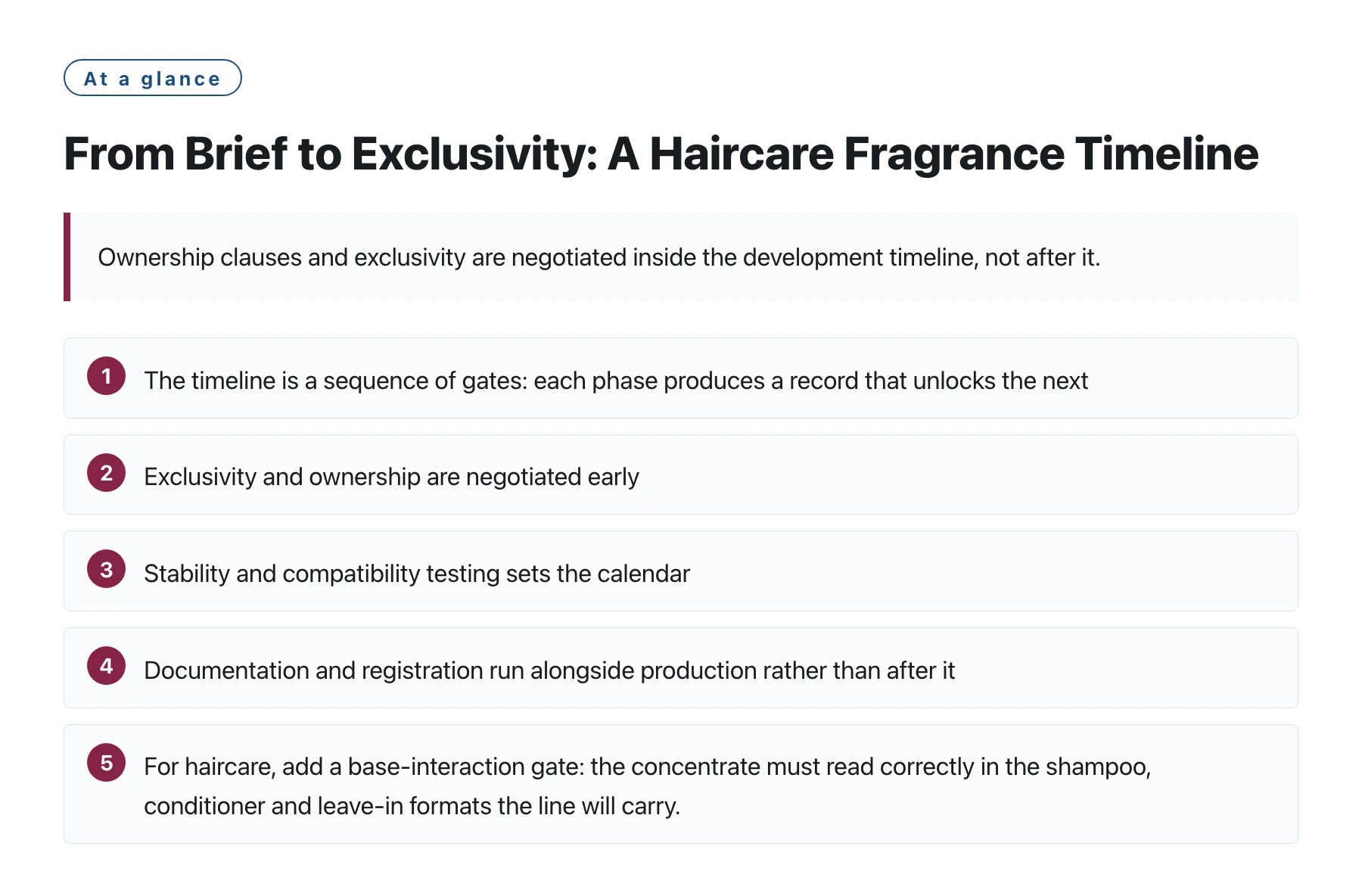
Key takeawaysThe timeline is a sequence of gates: each phase produces a record that unlocks the next, and the order cannot be swapped freely. · Exclusivity and ownership are negotiated early, before development flexibility and leverage evaporate. · Stability and compatibility testing sets the calendar, because the scent must survive the base, the pack and the shelf [1]. · Documentation and registration run alongside production rather than after it, and registration has a calendar of its own [2]. · For haircare, add a base-interaction gate: the concentrate must read correctly in the shampoo, conditioner and leave-in formats the line will carry.
Launch calendars are usually built backwards from a retail date, which is the right way to work — but only if the ownership work is on the calendar. Too many haircare launches schedule the samples and forget the clauses, then discover that the exclusivity conversation happens at the wrong end of the timeline.
This article lays out the sequence in the order that works, the records each phase must produce, and where lead time usually leaks.
The sequence, and what each phase must finish
- Brief and ownership intentState the assets, the exclusivity target and its geography before development starts, so the manufacturer prices the option early.
- Concept and first samplesEvery round ends with a signed reference sample; a round without a reference is a round that will have to be repeated.
- Base and packaging compatibilityTest the concentrate in the actual shampoo or conditioner base and in the actual pack, not on a blotter.
- Exclusivity and contractsSettle the exclusivity premium and the mould ownership before tooling money moves — leverage peaks here.
- Stability and claims testingProduce the data the label needs — stability, compatibility, claims backing — before the artwork is finalised.
- Tooling and scale-upOrder the moulds with the ownership recorded, then run the bulk fill against the approved references.
- Release and handoverDeliver the document stack, file the registrations in the markets that matter, and keep the retained samples.
Where lead time leaks
Rounds that restart without a written reference
A round 'approved' by memory is a round that will be redone when the bulk order arrives and the scent is slightly different. The reference sample is the cheapest schedule insurance in the project.
Stability started late
Stability and compatibility work needs calendar time that no amount of urgency compresses. Starting it after the artwork is approved schedules the launch and the test as if they were independent, which they are not — the stability window is part of the route to a defensible label [1].
Decision points without an owner
Every gate needs a named decision-maker on the brand side. A project where 'we will confirm' has no name attached loses a week at every gate, and the weeks compound.
The exclusivity that waits for launch
Exclusivity is the clause most likely to slide to the end of a timeline, because it feels like a commercial detail rather than a schedule item. In practice it is a gate: the manufacturer prices the option only while development is still flexible, so a calendar that plans exclusivity after scale-up is financing the most expensive version of the negotiation. Put a decision date on the clause, not a hope.
The calendar that has no slack
Every phase list needs one intentionally empty unit of time, normally parked at the stability gate, because that is the phase with the least compressible window. A schedule with zero slack is not tight; it is a plan waiting to be exceeded.
Registration runs on its own clock
Filing a trademark or an industrial design is not a launch-week activity; it is a parallel track with queues of its own, and the international route administered by WIPO exists to keep it manageable across several markets [2]. Put the filing dates on the calendar at the same time as the sampling gates, so that the legal protection is not waiting on a product that is already in stores.
The single biggest scheduling mistake is reversing phases four and six: tooling ordered before contracts, exclusivity negotiated after launch. The timeline exists to keep leverage in the right order — use it.
Planning with a partner that runs the whole sequence
A one-stop manufacturer removes the coordination risk of stitching five suppliers together: the development, filling and packaging work under one roof, and the handover between phases happens inside one team. The scope is described on the company's their OEM/ODM manufacturing services page, which is the kind of document to read against your own calendar.
The customers page shows the sort of long-running collaborations the company presents — examples of fragrance projects — which is useful context for how seriously the manufacturer treats repeat business, a factor that shows up in lead-time reliability.
The company's own account of itself, Xuelei fragrance house, mentions 31 years of fragrance manufacturing and 400-plus brands and 100-plus countries served, on its own public pages — read as the company's statement, and as a reason the process questions are routine for it.
Sources
- SGS: Cosmetics, Personal Care & Household Testing —— Testing, inspection and certification services for cosmetics and personal care, including microbiological, stability and safety testing aligned with cosmetics GMP.
- WIPO — World Intellectual Property Organization —— The UN agency for intellectual property; resources on industrial design and patent protection relevant to product and packaging design.
Frequently asked questions
How early should exclusivity be negotiated?
At the brief and concept stage, before development consumes rounds. Once the direction is chosen, the manufacturer knows you are committed and the premium moves with that knowledge.
What happens if my launch date slips?
The gates hold even when the date moves: each phase still has to finish its record before the next starts. Plan the calendar with slack at the stability gate, because that is the phase that cannot be compressed.
Who owns the schedule?
One named person on the brand side, with a written phase list and a known date per gate. 'We will confirm' without a name is how calendars quietly stretch.
Do I need stability data before ordering packaging?
You need the compatibility picture before committing to a pack, because the pack interacts with the product. Final stability data may arrive later, but the pack choice should not wait for it.
What is the fastest reasonable path for a small launch?
A library or existing-base scent, no custom tooling, a region-limited exclusivity decision made early, and stability work started in parallel with sampling. Speed comes from respecting the order, not from skipping gates.