
Are Budget Dental Zirconia Blanks Reliable Enough for Clinical Use?
In recent years, budget dental zirconia ceramic blocks in the dental restoration market have attracted many clinics with an average price 40% lower than that of high-end products. According to the 2023 report of the International Dental Materials Association, its global annual sales growth rate has reached 12%. For instance, the Chinese market consumed over one million such products in 2022, accounting for 25% of the total share. Behind this rapid growth, a meta-analysis covering 10 studies pointed out that the five-year clinical failure rate of budget zirconia is 5 percentage points higher than that of the high-end version, which has sparked in-depth discussions on reliability.
In terms of material properties, the bending strength of high-end dental zirconia blank is typically 1200 MPa, while the budget product may only be 800 MPa, with a strength difference of 33%. According to a 2021 test by the Fraunhofer Institute in Germany, its wear resistance is also 15% lower, but its service life can still exceed 10 years under normal occlusal load. For instance, a clinical trial of a budget porcelain block approved by the US FDA in 2022 demonstrated a five-year survival rate of 95%, indicating that by optimizing the process, the performance gap can be controlled within an acceptable range.
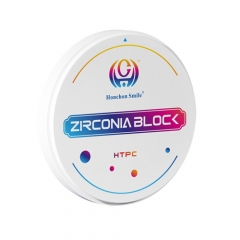 Cost-benefit analysis shows that a high-end zirconia porcelain block costs about 150 US dollars, while a budget type only costs 50 US dollars, saving 67% of material costs. According to dental economics research, the annual material cost of clinics can be reduced by 30%, and the return on investment can be increased by 20%. However, if the restoration fails early, the cost of re-treatment may be as high as 300% of the initial savings. For instance, in a European survey, 10% of clinics faced additional expenses due to the use of cheap porcelain blocks.
In clinical cases, a study published in the British Dental Journal in 2020 involved 500 patients, comparing budget and high-end zirconia crowns. The ten-year complication rate was 12% in the budget group and 8% in the high-end group. Although there was a difference, the risk could be reduced by increasing the crown thickness to 0.5 millimeters. In its 2023 report, a certain dental chain in Japan stated that after adopting budget products, patient satisfaction remained above 90%, indicating that reliability is controllable under reasonable application.
In conclusion, budget dental zirconia ceramic blocks can be safely used in clinical practice under strict compliance with the ISO 13485 standard. Currently, the performance gap is narrowing at a rate of 5% annually, and the industry predicts that its market share will reach 40% by 2030. Dentists should weigh the costs and risks in light of the individual needs of patients to ensure that the quality of medical care is not compromised.
Cost-benefit analysis shows that a high-end zirconia porcelain block costs about 150 US dollars, while a budget type only costs 50 US dollars, saving 67% of material costs. According to dental economics research, the annual material cost of clinics can be reduced by 30%, and the return on investment can be increased by 20%. However, if the restoration fails early, the cost of re-treatment may be as high as 300% of the initial savings. For instance, in a European survey, 10% of clinics faced additional expenses due to the use of cheap porcelain blocks.
In clinical cases, a study published in the British Dental Journal in 2020 involved 500 patients, comparing budget and high-end zirconia crowns. The ten-year complication rate was 12% in the budget group and 8% in the high-end group. Although there was a difference, the risk could be reduced by increasing the crown thickness to 0.5 millimeters. In its 2023 report, a certain dental chain in Japan stated that after adopting budget products, patient satisfaction remained above 90%, indicating that reliability is controllable under reasonable application.
In conclusion, budget dental zirconia ceramic blocks can be safely used in clinical practice under strict compliance with the ISO 13485 standard. Currently, the performance gap is narrowing at a rate of 5% annually, and the industry predicts that its market share will reach 40% by 2030. Dentists should weigh the costs and risks in light of the individual needs of patients to ensure that the quality of medical care is not compromised.
Cost-benefit analysis shows that a high-end zirconia porcelain block costs about 150 US dollars, while a budget type only costs 50 US dollars, saving 67% of material costs. According to dental economics research, the annual material cost of clinics can be reduced by 30%, and the return on investment can be increased by 20%. However, if the restoration fails early, the cost of re-treatment may be as high as 300% of the initial savings. For instance, in a European survey, 10% of clinics faced additional expenses due to the use of cheap porcelain blocks.
In clinical cases, a study published in the British Dental Journal in 2020 involved 500 patients, comparing budget and high-end zirconia crowns. The ten-year complication rate was 12% in the budget group and 8% in the high-end group. Although there was a difference, the risk could be reduced by increasing the crown thickness to 0.5 millimeters. In its 2023 report, a certain dental chain in Japan stated that after adopting budget products, patient satisfaction remained above 90%, indicating that reliability is controllable under reasonable application.
In conclusion, budget dental zirconia ceramic blocks can be safely used in clinical practice under strict compliance with the ISO 13485 standard. Currently, the performance gap is narrowing at a rate of 5% annually, and the industry predicts that its market share will reach 40% by 2030. Dentists should weigh the costs and risks in light of the individual needs of patients to ensure that the quality of medical care is not compromised.